

31 Dec Publishing a KDP Coloring Book (Part 1) – From Idea to Product
The story of my first KDP coloring book: From the birth of the idea to its eventual failure. It turned out to be much longer than I expected. To make it easier to follow, I’ve split it into two parts. In the first part, I’ll take you through the creative evolution of the idea and its execution. In the second part, I’ll share how I launched the book on Amazon Self Publishing, why it didn’t succeed, and the hard lessons I learned along the way.
The Longing for Creativity
I knew I wanted to work as an artist when I got pregnant. Seeing other mothers build businesses alongside their children, I assumed it would be possible for me, too. Why not? I thought the baby would sleep most of the day, which would be a great opportunity to work on my art. But the baby didn’t sleep as much as expected, I got very little sleep to be able to function normally, and we did not have a support system that would help us out. Everyone’s lives and circumstances are different, and in the end, I couldn’t make working while parenting work for me.
It was a hard pill to swallow, and I fell into a depression. My mental health started to get better only when I let go of the dream to be an artist for the time being. I realized my child needed me, so I prioritized their well-being over my own. I chose to focus on my family. But I kept on dreaming and waiting for the time when I could truly dedicate myself to art again.
A New Beginning in Thailand
The first time I felt that I had free time for myself was in the fall of 2024, when we moved to Thailand for the winter. Three days a week, I had a day entirely to myself to do whatever I wished. Since our child was on a two-nap schedule and the Asian weather was extremely hot, traveling around with her was difficult. We prioritized her well-being, which meant someone had to stay home. On my free days, my husband stayed with our daughter. I didn’t have friends in Thailand and I’m not the solo-traveler type, so I decided to start drawing again.
Simplifycation and The Birth of the Idea
During my pregnancy, an idea for a children’s book was born that I had long wanted to illustrate. I did some warm-ups and experimented with visual styles, but everything I drew turned out poorly. My hand was “stiff,” and I couldn’t get my exact vision onto paper. I have a specific vision for the book and couldn’t settle for inferior results. My drawing skills from years ago had faded, and I had no way of knowing how long it would take to restore them. This realization and time limitations made me wonder if it was even worth taking on such a massive project.
One day, I was reflecting on drawing and my ideas. A colored illustration requires a good sense of color, lighting theory, perspective, etc. What would be an easier way to draw? Sketching has always been a quick way to draw, but what to do with it? Sketches can also be detailed and complex. Simple line illustrations seemed faster and easier way to depict something. After thinking about it, I realized that these kinds of drawings are most commonly used in coloring books. Maybe I should create a coloring book?
Choosing the Niche: Houseplants
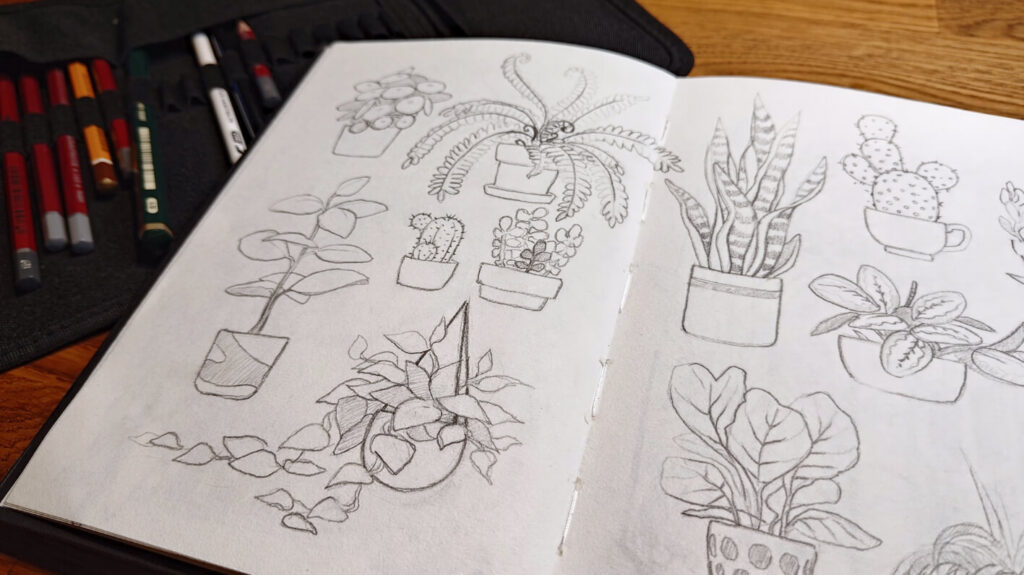
I took out my phone and searched “coloring book” on Amazon. There was a huge selection. At first, I just browsed, but then I thought about what topic would interest me and be easy to draw. Organic matter is quite forgiving when it comes to drawing mistakes. Since I’m a big fan of houseplants, I looked into that category. The plant niche was packed with coloring books. However, all the information I needed was that the niche exists. I didn’t do any further research or analysis and started drawing.
Developing the Visual Concept: Isometric Plant Rooms
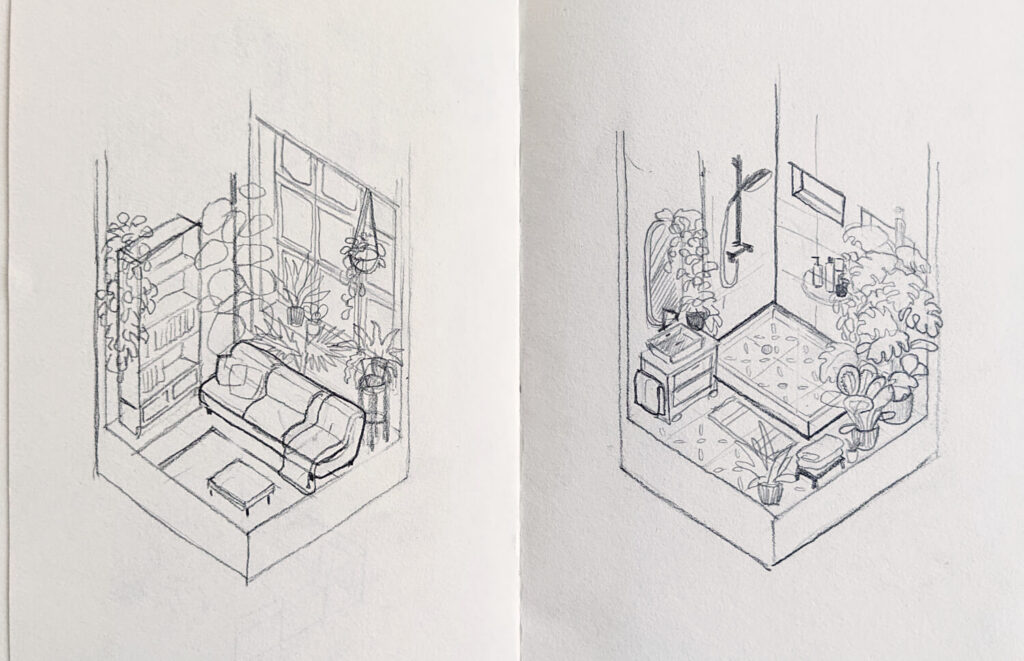
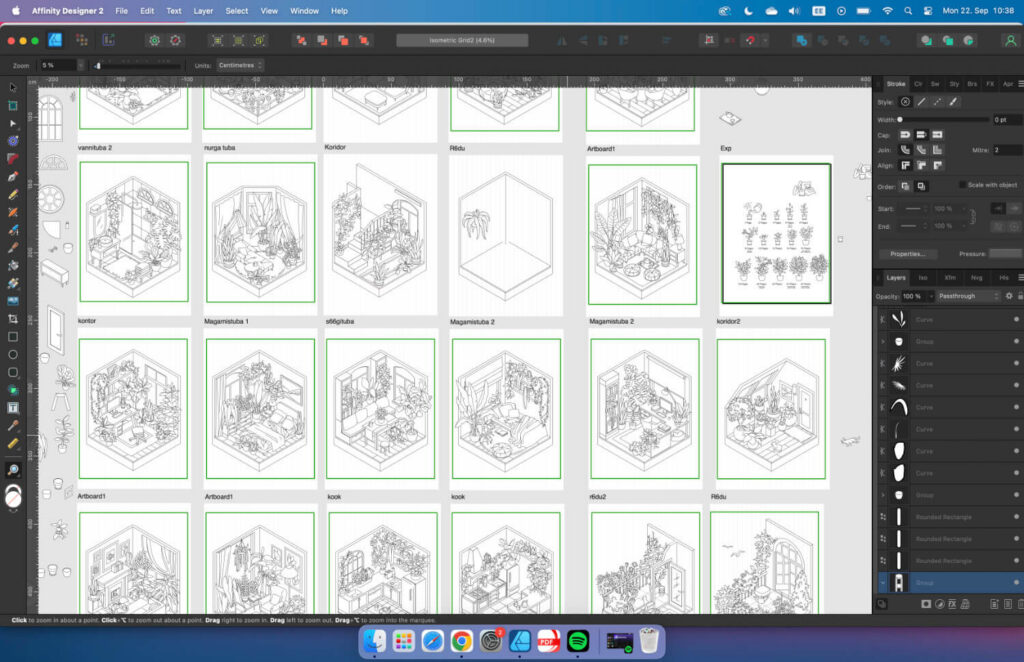
Thinking about my own houseplants, I had to admit that most of them are green regardless of their shape. From a colorer’s perspective, that didn’t seem exciting at all. While pot designs allow for more than one color, even exciting pots + plants didn’t seem to offer enough coloring variety in my opinion. Drawing houseplants in pots also felt boring. And then it clicked: interiors + plants = exciting “plant rooms.” This was an idea that sparked excitement in me both as an artist and a colorer.
I don’t remember exactly how that train of thought led to isometric rooms. But the idea was roughly that a semi-top-down view makes the room feel more three-dimensional, and the plants don’t get lost in one another. You can clearly color different plants and various room designs and furnishings. It was a solution offering plenty of possibilities and variety.
The Workflow and Technical Challenges
I started drawing the idea in a sketchbook with a regular pencil. Initially, I practiced drawing various plants using references to get the broadest possible overview of different leaf shapes. I did this for several days, but realized I couldn’t stay stuck sketching plants forever. I drew a rough isometric room base and started drawing room ideas.
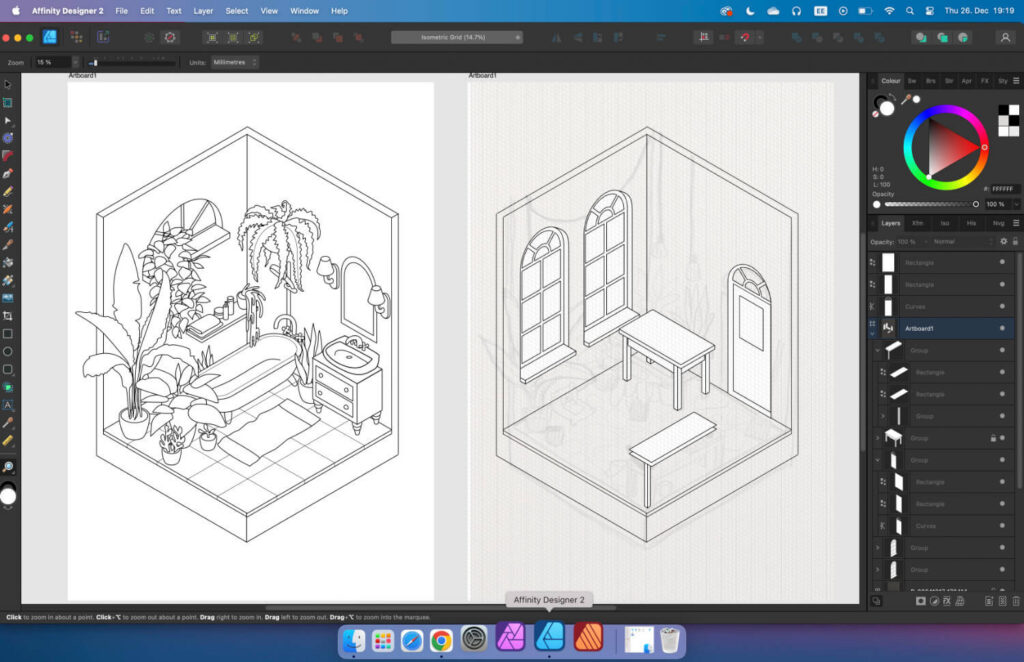
When I started sketching, I thought I’d finish about 30 sketches, photograph them, and then clean them up on the computer. However, even clumsy sketching took time, and it seemed this plan might be too slow. Again, the exact thought process escapes me, but the conclusion was that it would be more sensible to draw directly on the computer. Fortunately, I had my laptop and a 10-year-old graphics tablet with me.
Health Struggles and Setbacks
After initial troubles and adjustments, I started to get into the flow. I was drawing and having fun every free moment. I felt like I could finally fulfill my lifelong dream of becoming an artist. I felt amazing!
However, I had been drawing plant rooms for a few weeks when I was hit with the worst tonsillitis of my life, which made it impossible to sleep or function normally. I had to take a break. Once I recovered, Christmas and other plans intervened. But I wasn‘t worried, and I started drawing again at the beginning of January. However, a week later, the tonsillitis returned with a vengeance. Two weeks of treatment, and I thought I was cured, until a few days later, the whole ordeal started all over again. I was so frustrated and torn. I tried every remedy and health advice out there, but nothing worked. In the end, the tonsillitis lasted nearly 1.5 months. Most likely, the hot Asian temperatures combined with the icy air conditioning found everywhere didn’t suit me.
Return to Estonia and Recovery
I finally got healthy when we returned to Estonia, but that also marked the end of my free time, as I had to stay home with our toddler while my husband returned to his regular full-time job. The entire project remained on pause until August 2025, when our daughter started daycare.
At the beginning of the summer, I felt hopeless again and saw the early signs of my depression returning. I wasn’t sure if I would ever finish the coloring book, as finding time felt like a distant dream. My depression deepened even more, starting to affect my daily functioning. I realized I had to seek help. I started seeing a psychologist and started running. These two actions improved my quality of life significantly, and soon things started to move in the right direction again.
Committed to the Goal
Things fell into place when our toddler went to daycare. At first, it was only for a few hours, which eventually turned into full days after a two-month adjustment period. I picked up my coloring book project from where I had left off and discovered my motivation was as strong as ever. I think that was the moment the real development work began. I had so many creative ideas that I decided to finish the book at all costs. Even if it is just for myself.
The story will continue with Part 2 – The Launch and Failure
Until next time!

No Comments